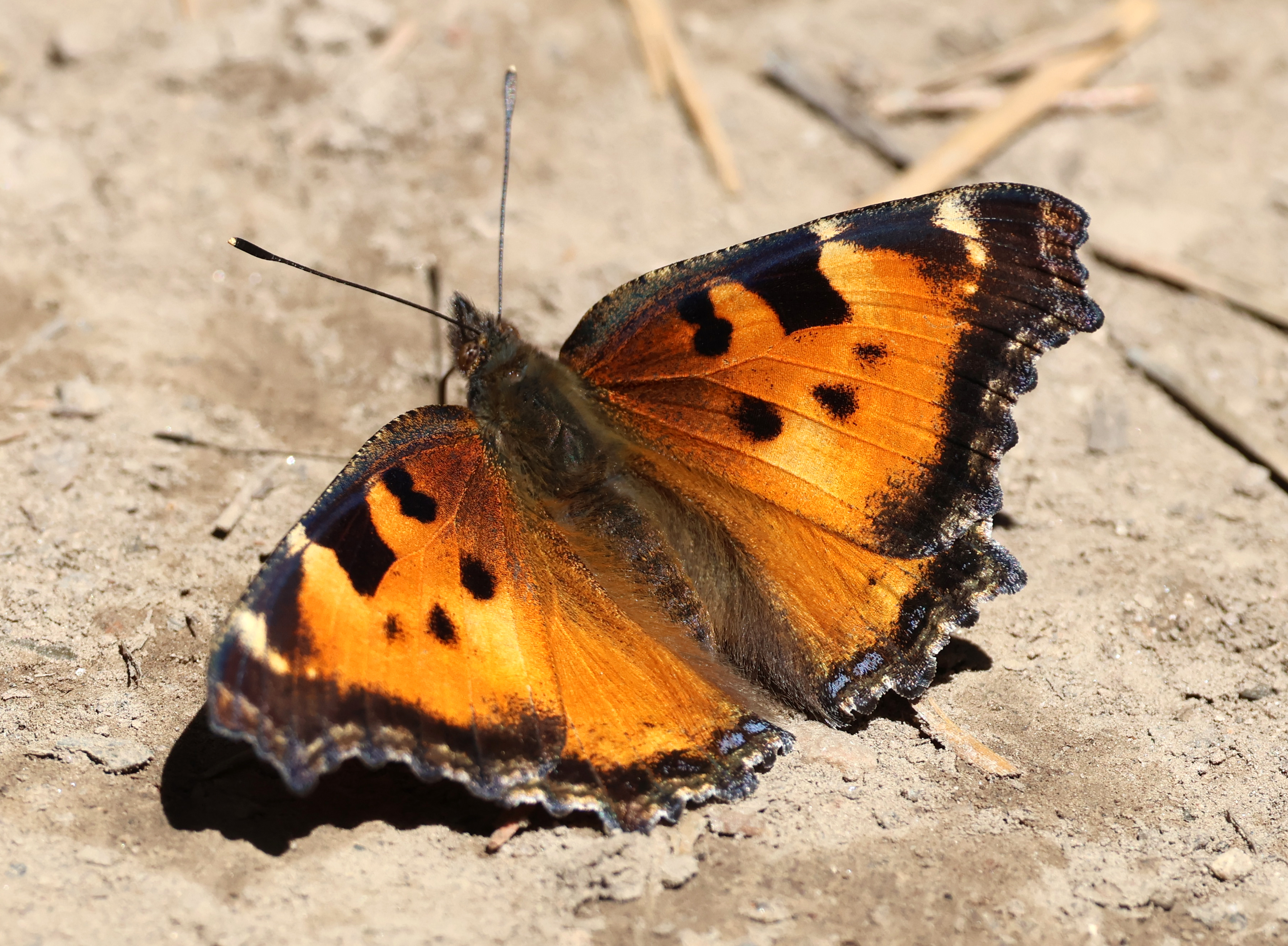
Millions of bright orange California tortoiseshell butterflies are swarming Northern California's mountains in summer 2026, and the boom traces back partly to Marin County, where large numbers were spotted this spring.
The population explosion, concentrated around Lassen Volcanic National Park and Lake Tahoe, descends from a parent generation that bred in the Santa Cruz Mountains and Marin County earlier this year, according to Patch. Warm, dry spring weather and abundant ceanothus, the native shrub commonly called California lilac, fueled a successful breeding season. The offspring matured and flew uphill into the Sierra Nevada, where cooler temperatures support the next stage of their life cycle.
For Southern Marin hikers, the connection is direct: ceanothus grows throughout the hillsides of Mount Tamalpais and is listed as a native species by the Marin Municipal Water District. The shrub is the sole food source for tortoiseshell caterpillars, making Tam's slopes prime habitat during the butterflies' foothill breeding phase each spring.
"It's probably a response to the Dixie Fire, which burned everything," Rachael Long, an emeritus adviser for the University of California Cooperative Extension, told SFGATE on July 30. "California lilacs power the nitrogen cycle for the Sierras and coastal foothills. After a fire, it has just totally taken over, and that's what the butterfly larvae are feeding on."
Long, a retired entomologist, encountered the swarm firsthand near her family's cabin on Lake Almanor. She described waves of butterflies streaming past as she drove toward Lassen National Park.
Matthew Forister, a biologist at the University of Nevada, Reno, told SFGATE the tortoiseshell is an "irruptive species" capable of unpredictable population booms. The last major explosion occurred in 2019 around Lake Tahoe. In 2004, a swarm 40 to 50 miles long and 15 miles wide traveled south along the Sierra Nevada, according to the National Park Service.
The two-inch butterflies have bright orange wings with dark markings and a mottled brown underside that camouflages against tree bark. They resemble monarchs in flight but belong to the brush-footed butterfly family.
No confirmed sightings on Mount Tamalpais trails have been independently reported this summer, but the species' life cycle suggests local hikers could see them again soon. According to the National Park Service, the butterflies migrate back downslope to foothill areas, including coastal regions like Marin, in late September to find hibernation sites for winter.
Residents hiking Tam or other Marin open spaces who spot clusters of orange butterflies resting on sunlit rocks or tree trunks may be seeing tortoiseshells estivating — entering a period of summer inactivity on mountaintops, living off fat stored during the caterpillar phase.
The National Park Service advises drivers in areas with heavy butterfly activity to travel under 30 mph, allowing the insects to drift over vehicles rather than collide with them.
What to watch for: The late September return migration is the next expected window for tortoiseshell sightings on Marin's foothill trails and open spaces. No guided butterfly walks or ranger programs have been announced locally.