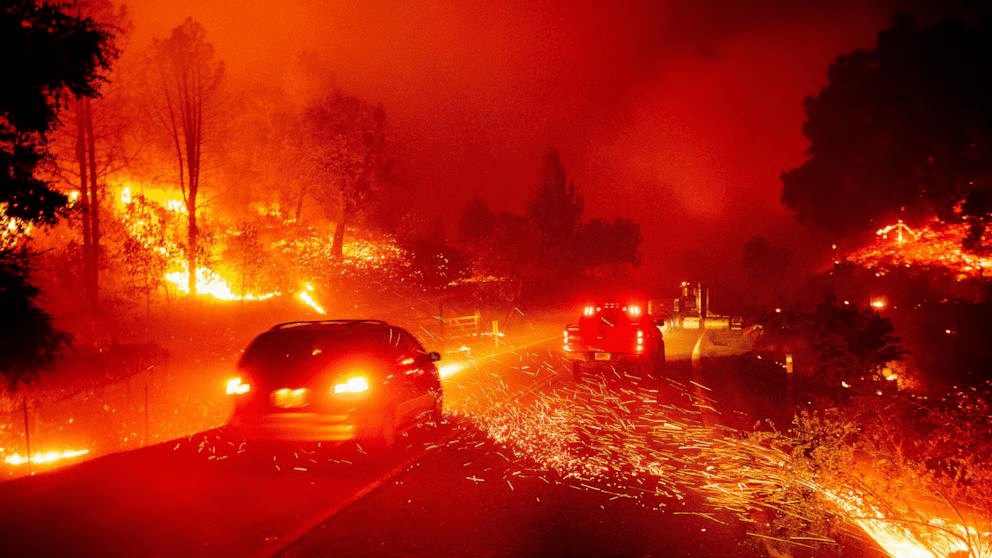
At community meetings across Marin, residents have told fire officials their biggest wildfire fear isn't the flames. It's the traffic.
They picture themselves trapped in a line of cars, fire closing in.
Central Marin Fire Battalion Chief Todd Lando says that fear could get them killed.
In an op-ed originally published in the Marin Independent Journal and republished by Fire Safe Marin on Monday, July 13, Lando wrote that some residents plan to skip car evacuation entirely. They say they'll shelter at home, leave on foot or by bicycle, or drive up fire roads into the hills. Lando, who also serves as president of Fire Safe Marin and as the department's wildfire hazard mitigation specialist, wrote that all of those alternatives are far more likely to be fatal than sitting in traffic.
What the fatality data shows
Lando pointed to the 2018 Camp Fire in Paradise, California, which killed 85 people. The large majority died at or near their homes. Of the eight who died in vehicles, none died because of traffic congestion, Lando wrote, citing fatality records from the incident. Paradise produced the worst wildfire evacuation gridlock ever documented in the United States. Thousands of residents sat in bumper-to-bumper traffic while the town burned around them.
They survived.
"The worst-case traffic scenario everyone fears actually happened, and the road was still the safest place to be," Lando wrote.
Those whose escape routes were cut off survived in parking lots and cleared ground that firefighters converted into refuge areas.
What this means for Larkspur and Corte Madera
Central Marin Fire's official evacuation guidance for Larkspur, Greenbrae, and Corte Madera reinforces Lando's argument. The department instructs residents to stay in their vehicles during evacuation because cars provide protection from smoke, radiant heat, and embers. The guidance also tells residents to evacuate downhill whenever possible, avoid fire roads and open space areas, and know at least two evacuation routes.
Residents do not need to wait for an official evacuation order. The department's guidance states: "If conditions seem dangerous, leave early."
A study by UC Santa Barbara researchers published in June 2026, reported by Bloomberg, found that 2.5 million Americans live in small towns at high wildfire risk with limited escape routes. Kentfield, with about 6,900 residents and only a few exits, was cited as an example. Lando wrote that the study never examined where people actually died, contending that fatalities cluster in homes, not on roads.
Marin agencies working on chokepoints
The Marin Wildfire Prevention Authority has been reducing roadside vegetation at evacuation chokepoints, targeting the kind of hazard that contributed to deaths in the 1991 Oakland Hills fire. MWPA Executive Officer Mark Brown told Bloomberg on July 7 that the agency's message is straightforward: leave early, take as few vehicles as possible, remain in your vehicle, and travel downhill.
The op-ed comes during an active fire-weather period. PG&E issued a Public Safety Power Shutoff notice for 2,022 Marin households from Wednesday, July 15 through Thursday, July 16, citing dry conditions, high temperatures, and high winds.
Lando's prescription: fix roads where they genuinely constrain escape through wider shoulders, parking limits on high-risk days, and roadside fuel reduction. And fix the fear.
Residents can sign up for Alert Marin emergency notifications at alertmarin.org.