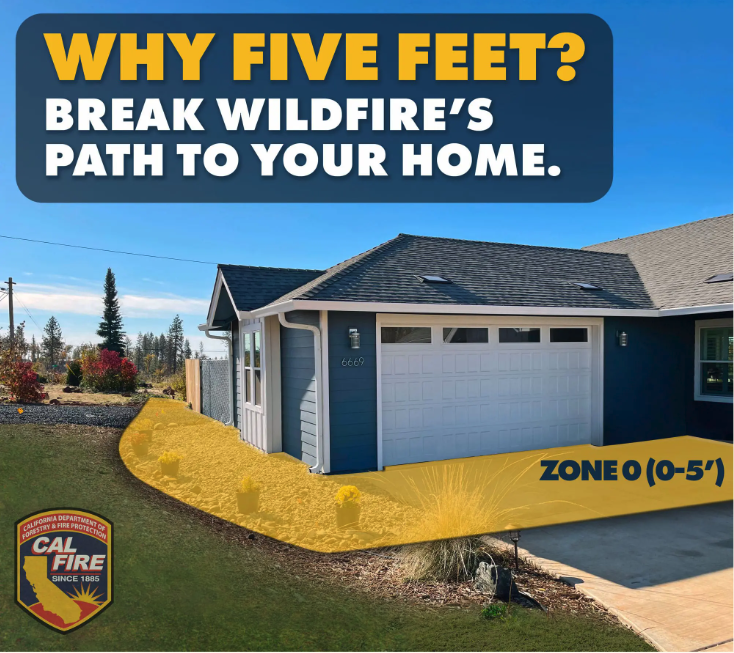
Southern Marin homeowners in wildfire-prone areas will need to clear combustible material within five feet of their homes under new state regulations explained in a Fire Safe Marin guide published Monday, Sept. 14.
The California Board of Forestry and Fire Protection unanimously adopted the Zone 0 rules Aug. 19. They have not yet taken effect. Fire Safe Marin's guide notes the regulations remain under review by the Board of Forestry and are expected to take effect in late September.
Zone 0 covers everything from a building's exterior walls, roof edge and attached decks, stairs or pergolas out to five feet. The state rules split that strip into a noncombustible safety zone closest to the structure and a low-combustibility zone extending to the five-foot boundary.
The safety zone must reach at least one foot from an exterior wall, two feet from windows, doors and vents, and five feet from attached decks, stairs and pergolas.
What has to go
The regulations ban combustible materials throughout Zone 0: fallen leaves, needles and twigs; bark and wood-chip mulch; firewood and stored lumber; dead or dying vegetation; and items stored beneath decks or balconies. Roofs and rain gutters must also be kept clear.
Phased deadlines for existing homes
New construction must comply as soon as the rules take effect. Existing homes get a phased timeline:
- Immediately: Remove combustible debris from roofs and gutters, remove firewood from Zone 0, remove dead tree branches and keep branches at least 10 feet from chimneys and clear of eaves.
- Within three years: Remove combustible mulch, wood chips, leaves and branches. Remove dead and dying plants. Complete required tree maintenance.
- Within five years: Local jurisdictions set a timeline for creating the vegetation-free safety zone next to the home, replacing combustible gates and making changes to fences, sheds and outbuildings.
Some low vegetation is allowed. Lawns and ground covers kept below three inches, small non-woody plants meeting spacing requirements, and plants no taller than 18 inches in movable noncombustible containers may stay.
Existing trees may remain if properly maintained, but new trees cannot be planted in Zone 0 once the rules take effect. Fences and gates that attach to a home must include a noncombustible five-foot section.
Who the rules cover
The state regulations apply to properties in the State Responsibility Area (SRA), which covers most of unincorporated Marin, and to properties in cities or towns mapped as Very High Fire Hazard Severity Zones. According to Fire Safe Marin, most homes inside Marin's cities and towns are not in the Very High category yet.
Marin's fire agencies are working toward a consistent countywide approach, with decisions resting with city councils and fire district boards.
Fire Safe Marin urges going beyond the minimum
Todd Lando, president of Fire Safe Marin and a battalion chief in the Central Marin Fire Department, spoke at the Board of Forestry's Aug. 19 hearing. Lando argued that allowing some flammable material in the zone forces inspectors into judgment calls. "Every judgment call is a dispute waiting to happen and every dispute lessens compliance and increases risk," Lando said at that hearing, as reported by the Marin Independent Journal.
Fire Safe Marin's guide calls the state regulation a legal floor and recommends keeping the entire first five feet free of anything that can burn. Research cited in the guide found that clearing the first five feet, combined with home hardening, roughly doubled a home's predicted chance of surviving a wildfire.
Insurance and local resources
Fire Safe Marin warns that insurance companies may expect a fully noncombustible five feet around a home. Meeting the state minimum may not satisfy an insurer.
The Southern Marin Fire Protection District earned a 2026 Fire Risk Reduction Community designation from the Board of Forestry, effective July 1, 2026. That designation requires California insurers to consider the recognition when setting residential rates.
The Marin Wildfire grant programs may help eligible residents complete Zone 0 improvements.